100% committed for democratic values

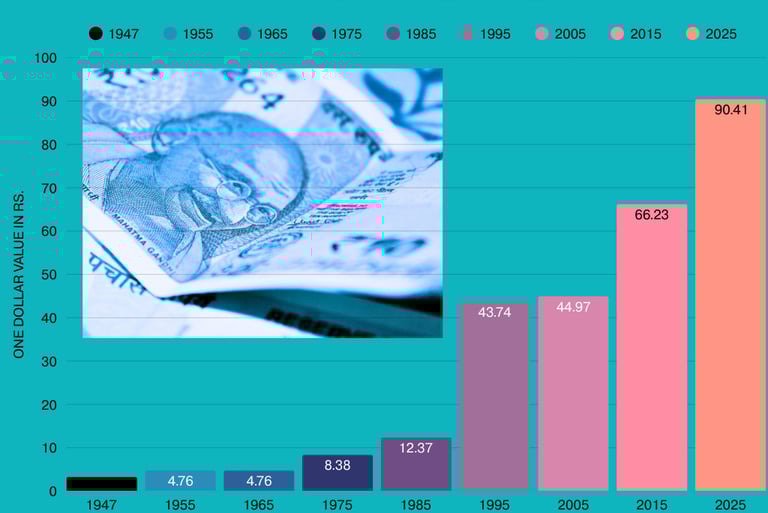
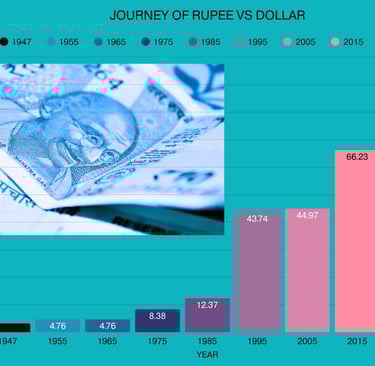
JOURNEY OF RUPEE VS DOLLAR SINCE 1947
RULING OF INDIA'S FAVOURITE PRINCE
Former Prime Minister Sri Atal Bihari Vajpayee, in his tribute to the first PM of Independent India, Sri Jawaharlal Nehru, said,"एक सपना चकनाचूर हो गया, एक गीत खामोश हो गया, एक लौ अनंत में विलीन हो गई। यह भय और भूख से मुक्त संसार का सपना था, यह एक महाकाव्य का गीत था जिसमें गीता की गूंज और गुलाब की सुगंध थी। यह उस दीपक की लौ थी जो रात भर जलती रही, हर अंधकार से लड़ती रही, हमें मार्ग दिखाती रही और एक सुबह निर्वाण प्राप्त कर लिया। भारत माता आज शोक में डूबी हैं - उन्होंने अपने प्रिय राजकुमार को खो दिया है। मानवता आज दुखी है - उसने अपने भक्त को खो दिया है। शांति आज बेचैन है - उसका रक्षक अब नहीं रहा। दलितों ने अपना आश्रय खो दिया है। आम आदमी की आंखों की रोशनी चली गई है।"
Vajpayee ji described Nehru ji as India's Favorite prince. Why?
It is not without reason. If you want to learn about them, then please go through the following humongous development activities during his regime as PM-
DEVELOPMENTS IN EDUCATIONAL SECTOR-
Central / National Institutes Established (1947–1964)
Indian Institutes of Technology (IITs)
These were created by the Government of India as premier engineering and technology institutes.
IIT Kharagpur – Established in 1951 (first IIT) under the Institutes of Technology Act.
IIT Bombay – Established in 1958.
IIT Madras – Established in 1959.
IIT Kanpur – Established in 1960 (operations began in 1959).
IIT Delhi – Established in 1961.
Medical Education & Research
All India Institute of Medical Sciences (AIIMS), New Delhi – Established in 1956 by an Act of Parliament as a central medical institute of excellence.
Management Education
Indian Institute of Management Calcutta (IIM Calcutta) – Established in 1961 as India’s first management institute.
Indian Institute of Management Ahmedabad (IIM Ahmedabad) – Established in 1961
Film & Media
Film and Television Institute of India (FTII), Pune – Established 1960 as a government educational institute for cinema and television.
Design & Related Fields
National Institute of Design (NID), Ahmedabad – Established 1961 as a government-initiated design school.
Other Government-Led Academic Entities
Jawaharlal Institute of Postgraduate Medical Education and Research (JIPMER), Puducherry – French-established before independence; taken over and renamed by India in 1964.
STATE UNIVERSITIES ESTABLISHED BETWEEN 1947 AND 1964-
1947: University of Rajasthan; Panjab University (re-established)
1948: Gauhati University
1950: Karnatak University
1952: Bihar University
1954: Sri Venkateswara University
1955: Jadavpur University, Sardar Patel University
1956: Kurukshetra University
1957: Vikram University; Gorakhpur University
DEVELOPMENTS IN THE INDUSTRIAL SECTOR-
Major Industries Established
1. Iron and Steel Industry
Steel was considered the backbone of industrial development.
Bhilai Steel Plant
Rourkela Steel Plant
Durgapur Steel Plant
2. Heavy Engineering Industries
These industries supported power, transport, and manufacturing.
Bharat Heavy Electricals Limited (BHEL)
Hindustan Machine Tools (HMT)
3. Defence and Aircraft Industry
To strengthen national security.
Hindustan Aeronautics Limited (HAL)
4. Oil and Petroleum Industry
For energy security and industrial fuel.
Indian Oil Corporation (IOC)
Expansion of oil refineries
Importance of These Industries
Laid the foundation for modern industrial India
Strengthened the public sector
Encouraged balanced regional development
DEVELOPMENTS IN FINANCIAL SECTOR-
After Independence, the Government of India focused on creating a strong, regulated financial system to support planned economic development. During 1947–1964, several important reforms and institutions were introduced.
1. Nationalisation of the Reserve Bank of India (1949)
The Reserve Bank of India (RBI) was nationalised in 1949.
It became fully owned by the Government of India.
RBI was empowered to control currency issues, credit policy, and banking regulation.
2. Banking Regulation Act, 1949
This Act gave the RBI authority to:
Regulate commercial banks
Ensure the safety of deposits
Prevent bank failures
It improved public confidence in banks.
3. Expansion of Public Sector Banking
Although major bank nationalisation happened later (1969), during this period:
Government control over banking increased
Branches of banks expanded slowly
Focus remained on urban and industrial financing.
4. Establishment of Development Financial Institutions (DFIs)
To support industrial growth, long-term finance institutions were set up:
Industrial Finance Corporation of India (IFCI) – 1948
State Bank of India (SBI) – 1955
Industrial Credit and Investment Corporation of India (ICICI) – 1955
Life Insurance Corporation of India (LIC) – 1956 (nationalisation of life insurance)
5. Nationalisation of Life Insurance (1956)
All private life insurance companies were merged to form LIC.
Aimed to:
Protect policyholders
Mobilise savings
Invest funds in national development projects
6. Promotion of Savings and Investment
Government encouraged:
Postal savings
Provident funds
Small savings schemes
These helped mobilise funds for Five-Year Plans.
7. Credit Control and Planned Economy
RBI used:
Bank rate policy
Selective credit controls
Credit was directed towards priority sectors like industry and infrastructure.
DEVELOPMENTS IN IRRIGATION PROJECTS AND POWER SECTOR-
After Independence, the Government of India gave top priority to irrigation and power development to strengthen agriculture, support industries, and promote economic growth. This period is often called the era of “temples of modern India.”
A. Developments in Irrigation Projects
Major Irrigation Projects
Large multipurpose river-valley projects were started to control floods, provide irrigation, and generate electricity.
Bhakra–Nangal Project (River Sutlej)
Hirakud Project (River Mahanadi)
Damodar Valley Project (River Damodar)
Nagarjuna Sagar Project (River Krishna)
Tungabhadra Project (River Tungabhadra)
Achievements in Irrigation
Increased irrigated area, especially in Punjab, Haryana, Andhra Pradesh, and Odisha
Helped improve agricultural productivity
Reduced dependence on monsoon rains
Supported Green Revolution groundwork
B. Developments in Power Sector
Expansion of Power Generation
Both hydroelectric and thermal power projects were developed.
1. Hydroelectric Power
Power generated from major dams like:
Bhakra–Nangal
Hirakud
Damodar Valley
Provided clean and cheap electricity.
2. Thermal Power
Thermal plants set up near coalfields.
Supported growing industries and urban centres.
Institutional Developments
Establishment of State Electricity Boards (SEBs)
Central government coordination for power planning
Expansion of transmission and distribution networks
Importance of Power Sector Development
Supported industrialisation
Promoted rural electrification
Improved transport, communication, and urban life
Boosted overall economic development.
DEVELOPMENTS IN MEDICAL FIELD-
1. Expansion of Medical Education
Establishment of new medical colleges across states
Increase in the number of trained doctors and nurses
Expansion of institutions like AIIMS, New Delhi (1956)
Improvement in postgraduate medical education
2. Establishment of Major Medical Institutions
All India Institute of Medical Sciences (AIIMS) – 1956
Indian Council of Medical Research (ICMR) strengthened
Central Government Health Scheme (CGHS) – 1954
3. Expansion of Public Health Infrastructure
Establishment of Primary Health Centres (PHCs) in rural areas
Expansion of district hospitals and urban health services
Focus on preventive and curative healthcare
4. Disease Control Programmes
National programmes launched to control major diseases:
National Malaria Control Programme (1953)
National Tuberculosis Programme
Leprosy control measures
Smallpox vaccination campaigns
5. Improvement in Maternal and Child Health
Expansion of maternity and child welfare centres
Training of midwives and health workers
Reduction in infant and maternal mortality rates
6. Development of Pharmaceutical Industry
Growth of public sector drug manufacturing units
Increased production of essential medicines and vaccines
Reduced dependence on imported medicines
7. Sanitation and Nutrition Programmes
Emphasis on clean drinking water
Nutrition programmes to combat malnutrition
Health education and awareness campaigns
8. Achievements of the Period
Improvement in life expectancy
Decline in death rates
Better access to healthcare services, especially in urban areas
DEVELOPMENTS IN DEFENCE SECTOR-
1. Reorganisation of the Armed Forces
Integration of princely state forces into the Indian Army
Creation of a unified Indian Army, Navy, and Air Force
Indianisation of officer ranks replacing British officers
2. Establishment of Defence Production Units
Ordnance Factories expanded for arms and ammunition
Hindustan Aeronautics Limited (HAL) strengthened for aircraft manufacturing
Bharat Electronics Limited (BEL) established (1954)
Growth of defence public sector undertakings
3. Formation of Defence Research Institutions
Defence Research and Development Organisation (DRDO) established in 1958
Promoted indigenous research in weapons, electronics, and missiles
4. Modernisation of the Armed Forces
Introduction of modern weapons and equipment
Expansion of air power and naval capabilities
Improved training facilities and military academies
5. Establishment of Military Training Institutions
Expansion of National Defence Academy (NDA)
Strengthening of military schools and training centres
6. Border Security and Strategic Preparedness
Strengthening of border infrastructure
Lessons learnt from wars of 1947–48 and 1962
Increased focus on defence preparedness after 1962
7. Development of Defence Policy
Emphasis on non-alignment and defensive posture
Focus on self-reliance rather than military alliances
DEVELOPMENT OF FIVE YEAR PLANS-
Jawaharlal Nehru was the Prime Minister when India adopted planned economic development. Three Five Year Plans were launched during his tenure.
1. First Five Year Plan (1951–1956)
Main focus: Agriculture and irrigation
Priority to food production
Development of irrigation projects like Bhakra–Nangal
Control of inflation after Partition
Laid the foundation for economic planning
2. Second Five Year Plan (1956–1961)
Main focus: Industrialisation
Based on the Mahalanobis Model
Emphasis on heavy industries and public sector
Establishment of steel plants (Bhilai, Rourkela, Durgapur)
Expansion of machine tools, power, and basic industries
3. Third Five Year Plan (1961–1966)
Main focus: Self-reliant economy
Aim to make India self-sufficient in food grains
Expansion of agriculture and industry together
Apart from the above mentioned aspects, there are many other fields and horizons where India progressed positively during Nehru regime.After considering all the above facts does any body still have doubt , why Pandit Jawaharlal Nehru is regarded as the "ARCHITECT OF MODERN INDIA".